
# Memory Guide
Memory enables Claude to retain context across sessions and conversations. It exists in two forms: automatic synthesis in claude.ai, and filesystem-based CLAUDE.md in Claude Code.
## Overview
Memory in Claude Code provides persistent context that carries across multiple sessions and conversations. Unlike temporary context windows, memory files allow you to:
- Share project standards across your team
- Store personal development preferences
- Maintain directory-specific rules and configurations
- Import external documentation
- Version control memory as part of your project
The memory system operates at multiple levels, from global personal preferences down to specific subdirectories, allowing for fine-grained control over what Claude remembers and how it applies that knowledge.
## Memory Architecture
Memory in Claude Code follows a hierarchical system where different scopes serve different purposes:
```mermaid
graph TB
A["Claude Session"]
B["User Input"]
C["Memory System"]
D["Memory Storage"]
B -->|User provides info| C
C -->|Synthesizes every 24h| D
D -->|Loads automatically| A
A -->|Uses context| C
```
## Memory Hierarchy in Claude Code
Claude searches for memory files in this order, with earlier locations taking precedence:
```mermaid
graph TD
A["Project Root"] -->|searches up| B["CLAUDE.md"]
B -->|highest priority| B1["Global instructions"]
A -->|searches down| C["Subdirectory CLAUDE.md"]
C -->|specific overrides| C1["Directory-specific rules"]
H["User Home"] -->|fallback| D["~/.claude/CLAUDE.md"]
D -->|personal preferences| D1["Personal settings"]
B1 -->|imports| E["@docs/architecture.md"]
E -->|imports| F["@docs/api-standards.md"]
```
## Memory Locations Table
| Location | Scope | Priority | Shared | Access | Best For |
|----------|-------|----------|--------|--------|----------|
| `./CLAUDE.md` | Project | High | Team | Git | Team standards, shared architecture |
| `./.claude/CLAUDE.md` | Project | High | Team | Git | Alternative project location |
| `./subdir/CLAUDE.md` | Directory | Medium | Team | Git | Directory-specific rules |
| `~/.claude/CLAUDE.md` | Personal | Low | Individual | Filesystem | Personal preferences |
| `~/.claude/my-project.md` | Personal | Low | Individual | Import | Project-specific personal notes |
## Memory Update Lifecycle
Here's how memory updates flow through your Claude Code sessions:
```mermaid
sequenceDiagram
participant User
participant Claude as Claude Code
participant Editor as File System
participant Memory as CLAUDE.md
User->>Claude: "Remember: use async/await"
Claude->>User: "Which memory file?"
User->>Claude: "Project memory"
Claude->>Editor: Open ~/.claude/settings.json
Claude->>Memory: Write to ./CLAUDE.md
Memory-->>Claude: File saved
Claude->>Claude: Load updated memory
Claude-->>User: "Memory saved!"
```
## Practical Examples
### Example 1: Project Memory Structure
**File:** `./CLAUDE.md`
```markdown
# Project Configuration
## Project Overview
- **Name**: E-commerce Platform
- **Tech Stack**: Node.js, PostgreSQL, React 18, Docker
- **Team Size**: 5 developers
- **Deadline**: Q4 2025
## Architecture
@docs/architecture.md
@docs/api-standards.md
@docs/database-schema.md
## Development Standards
### Code Style
- Use Prettier for formatting
- Use ESLint with airbnb config
- Maximum line length: 100 characters
- Use 2-space indentation
### Naming Conventions
- **Files**: kebab-case (user-controller.js)
- **Classes**: PascalCase (UserService)
- **Functions/Variables**: camelCase (getUserById)
- **Constants**: UPPER_SNAKE_CASE (API_BASE_URL)
- **Database Tables**: snake_case (user_accounts)
### Git Workflow
- Branch names: `feature/description` or `fix/description`
- Commit messages: Follow conventional commits
- PR required before merge
- All CI/CD checks must pass
- Minimum 1 approval required
### Testing Requirements
- Minimum 80% code coverage
- All critical paths must have tests
- Use Jest for unit tests
- Use Cypress for E2E tests
- Test filenames: `*.test.ts` or `*.spec.ts`
### API Standards
- RESTful endpoints only
- JSON request/response
- Use HTTP status codes correctly
- Version API endpoints: `/api/v1/`
- Document all endpoints with examples
### Database
- Use migrations for schema changes
- Never hardcode credentials
- Use connection pooling
- Enable query logging in development
- Regular backups required
### Deployment
- Docker-based deployment
- Kubernetes orchestration
- Blue-green deployment strategy
- Automatic rollback on failure
- Database migrations run before deploy
## Common Commands
| Command | Purpose |
|---------|---------|
| `npm run dev` | Start development server |
| `npm test` | Run test suite |
| `npm run lint` | Check code style |
| `npm run build` | Build for production |
| `npm run migrate` | Run database migrations |
## Team Contacts
- Tech Lead: Sarah Chen (@sarah.chen)
- Product Manager: Mike Johnson (@mike.j)
- DevOps: Alex Kim (@alex.k)
## Known Issues & Workarounds
- PostgreSQL connection pooling limited to 20 during peak hours
- Workaround: Implement query queuing
- Safari 14 compatibility issues with async generators
- Workaround: Use Babel transpiler
## Related Projects
- Analytics Dashboard: `/projects/analytics`
- Mobile App: `/projects/mobile`
- Admin Panel: `/projects/admin`
```
### Example 2: Directory-Specific Memory
**File:** `./src/api/CLAUDE.md`
```markdown
# API Module Standards
This file overrides root CLAUDE.md for everything in /src/api/
## API-Specific Standards
### Request Validation
- Use Zod for schema validation
- Always validate input
- Return 400 with validation errors
- Include field-level error details
### Authentication
- All endpoints require JWT token
- Token in Authorization header
- Token expires after 24 hours
- Implement refresh token mechanism
### Response Format
All responses must follow this structure:
```json
{
"success": true,
"data": { /* actual data */ },
"timestamp": "2025-11-06T10:30:00Z",
"version": "1.0"
}
```
Error responses:
```json
{
"success": false,
"error": {
"code": "VALIDATION_ERROR",
"message": "User message",
"details": { /* field errors */ }
},
"timestamp": "2025-11-06T10:30:00Z"
}
```
### Pagination
- Use cursor-based pagination (not offset)
- Include `hasMore` boolean
- Limit max page size to 100
- Default page size: 20
### Rate Limiting
- 1000 requests per hour for authenticated users
- 100 requests per hour for public endpoints
- Return 429 when exceeded
- Include retry-after header
### Caching
- Use Redis for session caching
- Cache duration: 5 minutes default
- Invalidate on write operations
- Tag cache keys with resource type
```
### Example 3: Personal Memory
**File:** `~/.claude/CLAUDE.md`
```markdown
# My Development Preferences
## About Me
- **Experience Level**: 8 years full-stack development
- **Preferred Languages**: TypeScript, Python
- **Communication Style**: Direct, with examples
- **Learning Style**: Visual diagrams with code
## Code Preferences
### Error Handling
I prefer explicit error handling with try-catch blocks and meaningful error messages.
Avoid generic errors. Always log errors for debugging.
### Comments
Use comments for WHY, not WHAT. Code should be self-documenting.
Comments should explain business logic or non-obvious decisions.
### Testing
I prefer TDD (test-driven development).
Write tests first, then implementation.
Focus on behavior, not implementation details.
### Architecture
I prefer modular, loosely-coupled design.
Use dependency injection for testability.
Separate concerns (Controllers, Services, Repositories).
## Debugging Preferences
- Use console.log with prefix: `[DEBUG]`
- Include context: function name, relevant variables
- Use stack traces when available
- Always include timestamps in logs
## Communication
- Explain complex concepts with diagrams
- Show concrete examples before explaining theory
- Include before/after code snippets
- Summarize key points at the end
## Project Organization
I organize my projects as:
project/
├── src/
│ ├── api/
│ ├── services/
│ ├── models/
│ └── utils/
├── tests/
├── docs/
└── docker/
## Tooling
- **IDE**: VS Code with vim keybindings
- **Terminal**: Zsh with Oh-My-Zsh
- **Format**: Prettier (100 char line length)
- **Linter**: ESLint with airbnb config
- **Test Framework**: Jest with React Testing Library
```
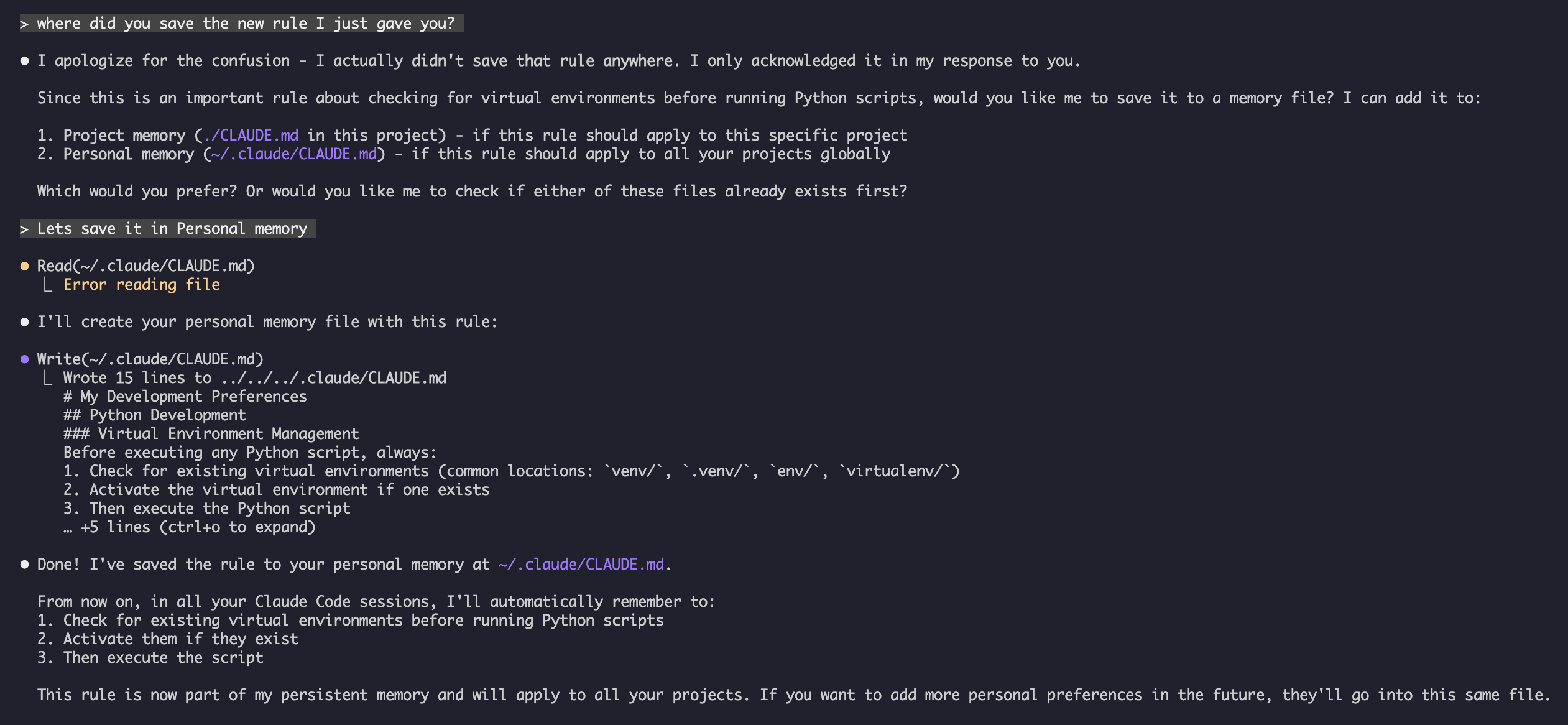
_My Test_
Ask Claude to save a new rule

Claude has not save the rule because I did not have any `Claude.md` file anywhere. Then asked Claude to confirm the location.
### Example 4: Memory Update During Session
**Session Interaction:**
```markdown
User: Remember that I prefer using React hooks instead of class components
for all new components.
Claude: I'm adding that to your memory. Which memory file should this go in?
1. Project memory (./CLAUDE.md)
2. Personal memory (~/.claude/CLAUDE.md)
User: Project memory
Claude: ✅ Memory saved!
Added to ./CLAUDE.md:
---
### Component Development
- Use functional components with React Hooks
- Prefer hooks over class components
- Custom hooks for reusable logic
- Use useCallback for event handlers
- Use useMemo for expensive computations
```
## Memory Features Comparison
| Feature | Claude Web/Desktop | Claude Code (CLAUDE.md) |
|---------|-------------------|------------------------|
| Auto-synthesis | ✅ Every 24h | ❌ Manual |
| Cross-project | ✅ Shared | ❌ Project-specific |
| Team access | ✅ Shared projects | ✅ Git-tracked |
| Searchable | ✅ Built-in | ✅ Through `/memory` |
| Editable | ✅ In-chat | ✅ Direct file edit |
| Import/Export | ✅ Yes | ✅ Copy/paste |
| Persistent | ✅ 24h+ | ✅ Indefinite |
### Memory in Claude Web/Desktop
#### Memory Synthesis Timeline
```mermaid
graph LR
A["Day 1: User
Conversations"] -->|24 hours| B["Day 2: Memory
Synthesis"]
B -->|Automatic| C["Memory Updated
Summarized"]
C -->|Loaded in| D["Day 2-N:
New Conversations"]
D -->|Add to| E["Memory"]
E -->|24 hours later| F["Memory Refreshed"]
```
**Example Memory Summary:**
```markdown
## Claude's Memory of User
### Professional Background
- Senior full-stack developer with 8 years experience
- Focus on TypeScript/Node.js backends and React frontends
- Active open source contributor
- Interested in AI and machine learning
### Project Context
- Currently building e-commerce platform
- Tech stack: Node.js, PostgreSQL, React 18, Docker
- Working with team of 5 developers
- Using CI/CD and blue-green deployments
### Communication Preferences
- Prefers direct, concise explanations
- Likes visual diagrams and examples
- Appreciates code snippets
- Explains business logic in comments
### Current Goals
- Improve API performance
- Increase test coverage to 90%
- Implement caching strategy
- Document architecture
```
## Best Practices
### Do's - What To Include
- **Keep organized**: Structure memory files with clear sections
- **Keep up-to-date**: Review and update memory regularly as standards change
- **Use project memory for**: Team standards, architecture, coding conventions
- **Use personal memory for**: Preferences, communication style, tooling choices
- **Use directory memory for**: Module-specific rules and overrides
- **Version control**: Commit CLAUDE.md files to git for team benefit
- **Import docs**: Reference external files with @docs/file.md syntax
- **Be specific**: Provide concrete examples and clear expectations
### Don'ts - What To Avoid
- **Don't store secrets**: Never include API keys, passwords, or credentials
- **Don't duplicate**: Avoid repeating content across memory files
- **Don't create too many**: Keep subdirectory overrides minimal and focused
- **Don't make it too long**: Keep memory files under 500 lines
- **Don't include sensitive data**: No PII, private information, or proprietary secrets
- **Don't forget to update**: Memory becomes stale if not maintained
- **Don't over-organize**: Use hierarchy strategically, not excessively
## Installation Instructions
### Setup Project Memory
1. **Create a CLAUDE.md in your project root:**
```bash
cd /path/to/your/project
touch CLAUDE.md
```
2. **Add project standards:**
```bash
cat > CLAUDE.md << 'EOF'
# Project Configuration
## Project Overview
- **Name**: Your Project Name
- **Tech Stack**: List your technologies
- **Team Size**: Number of developers
## Development Standards
- Your coding standards
- Naming conventions
- Testing requirements
EOF
```
3. **Commit to git:**
```bash
git add CLAUDE.md
git commit -m "Add project memory configuration"
```
### Setup Personal Memory
1. **Create ~/.claude directory:**
```bash
mkdir -p ~/.claude
```
2. **Create personal CLAUDE.md:**
```bash
touch ~/.claude/CLAUDE.md
```
3. **Add your preferences:**
```bash
cat > ~/.claude/CLAUDE.md << 'EOF'
# My Development Preferences
## About Me
- Experience Level: [Your level]
- Preferred Languages: [Your languages]
- Communication Style: [Your style]
## Code Preferences
- [Your preferences]
EOF
```
### Setup Directory-Specific Memory
1. **Create memory for specific directories:**
```bash
mkdir -p /path/to/directory/.claude
touch /path/to/directory/CLAUDE.md
```
2. **Add directory-specific rules:**
```bash
cat > /path/to/directory/CLAUDE.md << 'EOF'
# [Directory Name] Standards
This file overrides root CLAUDE.md for this directory.
## [Specific Standards]
EOF
```
3. **Commit to version control:**
```bash
git add /path/to/directory/CLAUDE.md
git commit -m "Add [directory] memory configuration"
```
### Verify Setup
1. **Check memory locations:**
```bash
# Project root memory
ls -la ./CLAUDE.md
# Personal memory
ls -la ~/.claude/CLAUDE.md
```
2. **Claude Code will automatically load** these files when starting a session
3. **Test with Claude Code** by starting a new session in your project
## Related Concepts Links
### Core Memory Concepts
- [CLAUDE.md File Format Guide](./examples/)
- [Memory Examples](./examples/)
- [Memory Hierarchy](./examples/)
### Integration Points
- [MCP Protocol](../05-mcp/) - Live data access alongside memory
- [Slash Commands](../01-slash-commands/) - Session-specific shortcuts
- [Skills](../03-skills/) - Automated workflows with memory context
### Best Practices
- [Code Organization](./examples/)
- [Team Collaboration](./examples/)
- [Documentation Strategy](./examples/)
### Related Claude Features
- [Claude Web Memory](https://claude.ai) - Automatic synthesis
- [File Imports](./examples/) - Reference external documentation
- [File Context](../01-context-window/) - Current session context